What $71 and a Bad Cold Taught Me About Fundraising

My first year directing, I was confident I had fundraising figured out.
I was going to sell program ads, move candy bars, and, my personal favorite, sell wrapping paper through a very enthusiastic man who promised me "thousands with only minutes a month." I don't know which of us was more optimistic.
The program cost more to print than the ads ever brought in. The candy bars put me directly in the cross-hairs of the orchestra conductor who, as best I could tell, had been selling candy bars since before Hershey himself was born. And the wrapping paper? We sold five rolls, two parents got the wrong order, and I spent hours on the phone with a slick salesperson trying to explain our complete failure.
Year one: disaster.
Year two: modest results and a lot of hope.
Year three, my students and I landed on something we were sure would change everything.
We would sell "Lights of the Season." For one dollar, you could honor a friend, a teacher, a family member. They would receive a handwritten card, delivered in person, and a light placed on the big live Christmas tree in the front oval of our school. That tree was already there, already beautiful. We just claimed it. We strung 50 feet of extension cords out to it, decorated the branches, and planned a free hot chocolate and caroling night around the official lighting. Families would gather outside in the December cold, the tree would glow, and the whole school community would feel it.
Triple winner. Foolproof. Possibly genius.
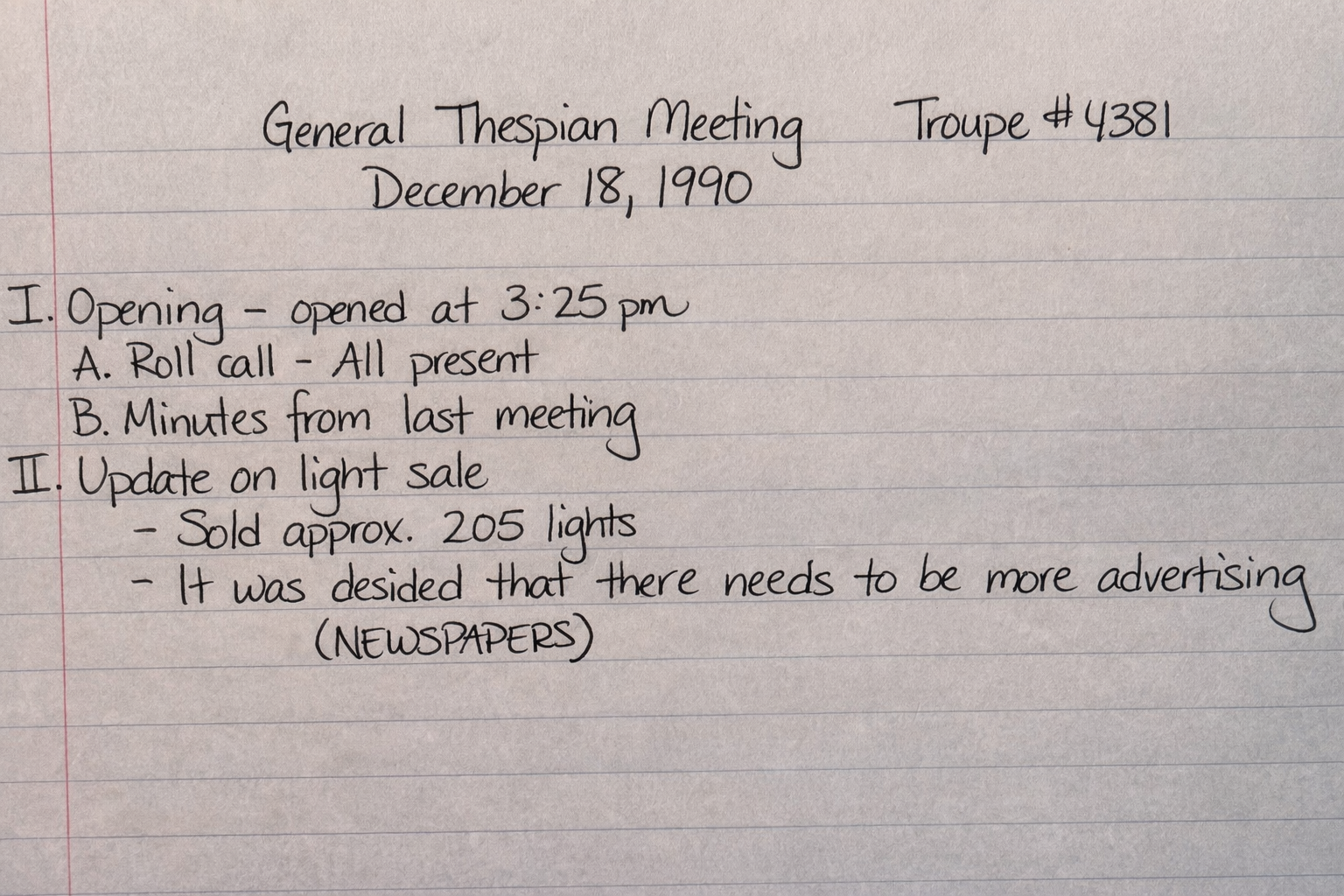
We sold approximately 205 lights. I know this because I recently found the actual handwritten Thespian Troupe #4381 meeting minutes from December 18, 1990. They read: "update on light sale. Sold approx. 205 lights. It was decided that there needs to be more advertising. (NEWSPAPERS)."
Right. The problem was newspaper coverage. That was definitely the problem.
Before you start clapping about the 205 lights, let me finish.
The printed cards, envelopes, and invitations cost $34. The strings of lights cost $60, because one strand was never going to do justice to a tree that size. Hot chocolate, cookies, and cups ran another $20. The napkins were generously donated by the school cafeteria. They were not fully aware they had donated them. I assume they know now. I also bought pizza and soda for the students who came in on several cold December nights to write all 205 cards. Another $20.
It was, genuinely, a beautiful evening. Families stood outside in the snow. The tree lit up. Kids sang. People smiled. I had leftover cookies for rehearsal the next night.
And after $134 in costs, we finished with $71 and a bad cold.
A parent found me after the event, still glowing from the whole thing, and said something I have not forgotten in the 35 years since. "Next time, just ask the parents and their friends. We love that the kids are involved. We can help."
She was not wrong. We were so busy being clever that we forgot to be direct. We planned around our community instead of with them.
{{quote}}
The Fundraising Lesson I Learned Too Late
That lesson, embarrassingly simple as it was, became the foundation of almost everything that worked after that. We stopped trying to extract money from our community and started inviting them into the experience. The best fundraisers we ran were moments people wanted to be part of. A VIP Lounge before opening night, where donors felt like insiders. A haunted house the drama kids built and ran themselves, where the same families who watched them sing and dance every spring paid to be scared by them in October. A movie night on the school lawn where people brought blankets and the program felt like something the whole town owned together.
And then there was the Bard-B-Que.
We performed Shakespeare outside. Hot dogs, burgers, salads, desserts, all free. Families spread out blankets and lawn chairs, and we did Shakespeare the way it was probably always meant to be done: loud, funny, and slightly chaotic in the best possible way. When the donation barrel came around, people whooped and threw money in. Not because they felt obligated. Because they were having the time of their lives and wanted to be part of what made it happen.
That is the whole lesson, right there in a barrel.
Once you see the difference between a fundraiser people endure and one they talk about on Monday morning, you stop planning campaigns and start planning experiences.
What Actually Works in Performing Arts Fundraising
Most of us were never taught how to raise money without making it feel awkward, exhausting, or like one more thing we had to survive.
Most performing arts directors came up through the craft. We studied the work. Nobody really taught us how to raise money well. After 34 years of directing and a few years building tools for programs like the ones I ran, here is what I have learned about what actually works.
Start with a direct ask before you start selling anything. Before you sell a single thing or plan any event, reach out to your twenty-five or thirty strongest supporters, parents, alumni, and community advocates, and tell them exactly what you need and why. No product. No gimmick. Honest communication about your program and what it takes to keep it running. A direct ask will almost always outperform a product sale, and it costs nothing but the time to make the call or write the note. The parent by the Christmas tree was right about this one.
Know your community before you pick your method. A candy bar sale works in some communities and dies quietly in others. A gala works for a community theatre with an established donor base and does nothing for a school program whose families work two jobs. The method is not the point. The point is knowing your people, what moves them, and what they can actually give.
Make it an experience, not a transaction. The fundraisers that raised the most money in my program were the ones where people got something beyond a receipt. Not a product, an experience. A seat at a special event. A behind-the-scenes moment. A memory tied to something your program created.
Time your ask or waste your ask. Right now, a lot of arts organizations are feeling the squeeze. Contributed revenue dropped 30% from 2023 to 2024, with every single source declining year over year. That is real. At the same time, arts, culture, and humanities giving still reached an all-time high in 2024, even adjusted for inflation. So yes, it is harder, but the donors are still out there. What often goes wrong is timing. Asking during your busiest production week, or right after you already asked twice this season, does not fail because people do not care. It fails because the moment is wrong. Build your calendar around your community's rhythms, not just your budget deadlines.
Remove every obstacle between good intentions and giving. Any friction can kill a fundraiser. Too many steps, unclear instructions, a clunky payment process, people give up. Make it easy.
Stay connected year-round, not just when you need something. The programs that raise the most money year after year are usually the ones that stay closest to their community between campaigns. A genuine thank-you after every gift. A personal update to your top supporters before opening night. A public shoutout to a volunteer who showed up when you needed them. These feel small. They are not small. They are the reason someone says yes next year without being asked twice.
{{quote}}
Fundraising Tips for Busy Theatre Directors
- Start with a direct ask before you sell a single thing
- Match your fundraising method to your specific community, not what worked somewhere else
- Build experiences people want to be part of, not transactions they feel pressured into
- Time your campaigns around your community’s calendar, not just your budget needs
- Make giving as easy and friction-less as possible
- Stay connected year-round, not just when you need something
- Say thank you every time, specifically and personally
I did not crack fundraising that December. But I learned something more useful than a strategy. I learned that people who love what your program does will give generously when you invite them into it, and barely at all when you just ask them to buy something.
Every successful fundraiser I ran after that traced back to that cold night and that parent's honest advice.
The tree in the school oval was trying to teach me something, even if it took me a few more years to name it. The goal was never just to raise money. It was to build something people wanted to be part of, and worth supporting.
NOTE: If this sounds familiar, and you are tired of selling things people do not really want just to raise money your program actually needs, we put together Fundraising Without the Headache. It is a practical guide full of fundraising ideas, communication tips, and planning help for performing arts programs that want to raise more money with less chaos.
.png)
{{quote}}
New resources,
straight to your inbox
We'll send you the latest guides, spotlights, and webinars — no noise, just the good stuff for arts organizations like yours. No spam, unsubscribe anytime.



























.png)