Ticket Prices Across Performing Arts Have Risen for a Decade. Here Is What That Means If Yours Have Not.
Direct Answer:
Ludus transaction data shows that performing arts ticket prices have risen consistently since 2014, while a significant portion of K-12 organizations and theatres have not updated prices in three or more years. Organizations with stagnant pricing tend to earn less per ticket and sell fewer tickets than peers who have kept pace with the market.
Intro
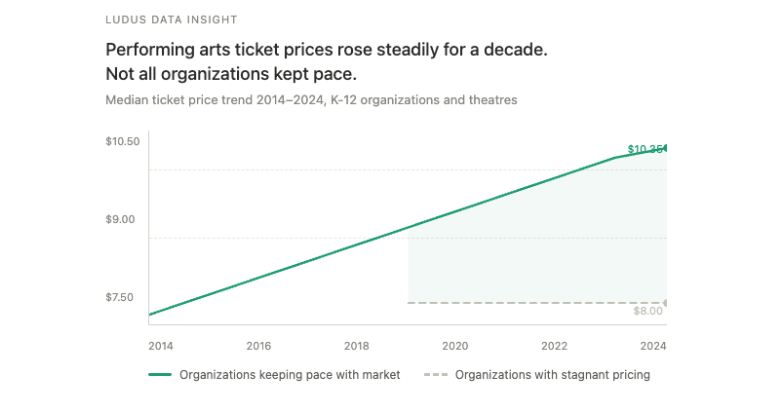
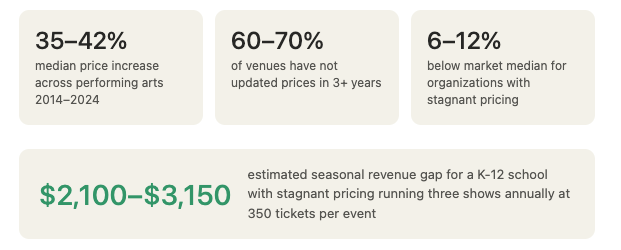
Performing arts audiences have absorbed consistent ticket price increases for more than a decade. Across K-12 organizations and theatres, median ticket prices rose 35 to 42 percent between 2014 and 2024. In the data analyzed, attendance did not show a consistent decline alongside those increases. In several segments it recovered and grew following the disruptions of 2020. For organizations that kept pace, that trend compounded into meaningfully higher revenue over time. For those that did not, the gap is larger than it probably feels from the inside.
Key Insight
Across the events analyzed, K-12 organizations and theatres that have not updated ticket prices in three or more years show a consistent pattern. They sit 6 to 12 percent below the market median on price, depending on how long prices have been static.
That gap is expected. What is less expected is what happens to ticket volume at the same time. Organizations with stagnant pricing tend to sell fewer tickets on average than peers pricing at or above their segment median.
The combined effect is measurable. A K-12 school producing three shows annually at $8 per ticket, when similar schools in the same region have moved to $10 to $11, is not just earning $2 or $3 less per ticket. Across a typical event at 350 tickets, that gap represents roughly $700 to $1,050 per show. Over a three-show season, that is $2,100 to $3,150 in revenue the program does not see.
These figures show a pattern, not a single cause. Organizations with stagnant pricing often show other signs of falling behind, including less frequent marketing and older production infrastructure. The data does not prove that pricing alone causes lower ticket volume. But the pattern is hard to ignore: when price falls behind the market, ticket volume often falls behind too.
What This Means
Performing arts audiences appear to make attendance decisions based largely on the show, the organization's reputation, and convenience. Within a reasonable range, the data suggests price may be less of a barrier than many organizations assume. But price still sends a signal before a patron buys.
A ticket priced meaningfully below comparable organizations may suggest, unintentionally, that the production is less substantial than it really is. Organizations pricing below their segment median are not just earning less per ticket. They are reaching fewer patrons.
The market has also simply moved. A price that has not changed since 2018 or 2019 may register as out of step with what patrons expect to pay.
None of this means every organization should raise prices aggressively. Accessibility matters. Student audiences, family budgets, and community expectations matter. The point is not to charge more because the market moved. The point is to review pricing intentionally instead of letting an old number become policy.
What To Do With It
Start by checking when your organization last updated ticket prices. If it has been more than two years, compare your current price against similar organizations in your region and segment. The gap between your price and the segment median is the most useful starting point, not a national average, which obscures the differences that actually matter to your specific audience.
Small, consistent increases over time are easier for patrons to absorb than a single large adjustment after years of no change. An annual review tied to your season planning calendar is a practical starting point.
If you are uncertain what comparable organizations charge, peer benchmarking by show type, region, and organization size gives a more accurate picture than general market data. The organizations most relevant to your pricing decisions are the ones your patrons might also attend, not the ones on the other side of the country.
Closing
The performing arts market has moved steadily for ten years. Organizations that have kept pace have compounded the gains quietly, show by show and season by season. The gap for those that have not is real, measurable, and worth looking at directly. The question is whether your current pricing reflects the market your patrons are actually living in.


New resources,
straight to your inbox
We'll send you the latest guides, spotlights, and webinars — no noise, just the good stuff for arts organizations like yours. No spam, unsubscribe anytime.


























.png)