Best Ticketing Software for Performing Arts in 2026: What Most Comparisons Miss

A practical guide for schools, community theatres, dance organizations, music ensembles, independent venues, and performing arts venues choosing ticketing software.
Editor's note: This guide was last reviewed in July 2026. Pricing, features, and support policies can change, so confirm current details directly with each vendor before making a final decision. Ludus is included in this guide because it belongs in the conversation. The goal here is to be useful first.
Most “best ticketing software” articles are written for a different kind of buyer.
Ticketing software looks like a ticket-selling decision right up until a volunteer needs to exchange four seats, a parent needs to pay for a class, or the concession line stretches into the lobby.
That is when the differences between these products become clear. The wrong system does more than frustrate the box office. It creates extra work throughout the season, often for the same small team already producing the shows, answering patron questions, raising money, and keeping the front of house moving.
This guide is for schools, community theatres, independent venues, dance organizations, music ensembles, and performing arts venues that need software to fit how they actually operate. That means ticketing, yes, but also fundraising, patron communication, volunteer coordination, registrations, concessions, onboarding help, and support when something goes sideways close to curtain.
The short answer
For many performing arts organizations, the best ticketing software is not the one with the flashiest demo. It is the one that fits the full shape of the work.
Some groups only need simple ticket sales. Most performing arts organizations do not.
They need a broader platform that can handle fundraising, marketing, patron segmentation, volunteer management, concessions, registrations, and payment collections without forcing them into five extra logins and a patchwork of tools. That is where Ludus stands out. Ludus is built specifically for performing arts organizations that need more than ticketing alone, and it does that without setup fees, annual fees, or contracts.
That does not mean every organization should buy the same platform. It does mean the field gets smaller fast once buyers stop asking, “Who sells tickets?” and start asking, “Who actually helps me run the season?”
Quick answers by need
These are starting points, not final verdicts.
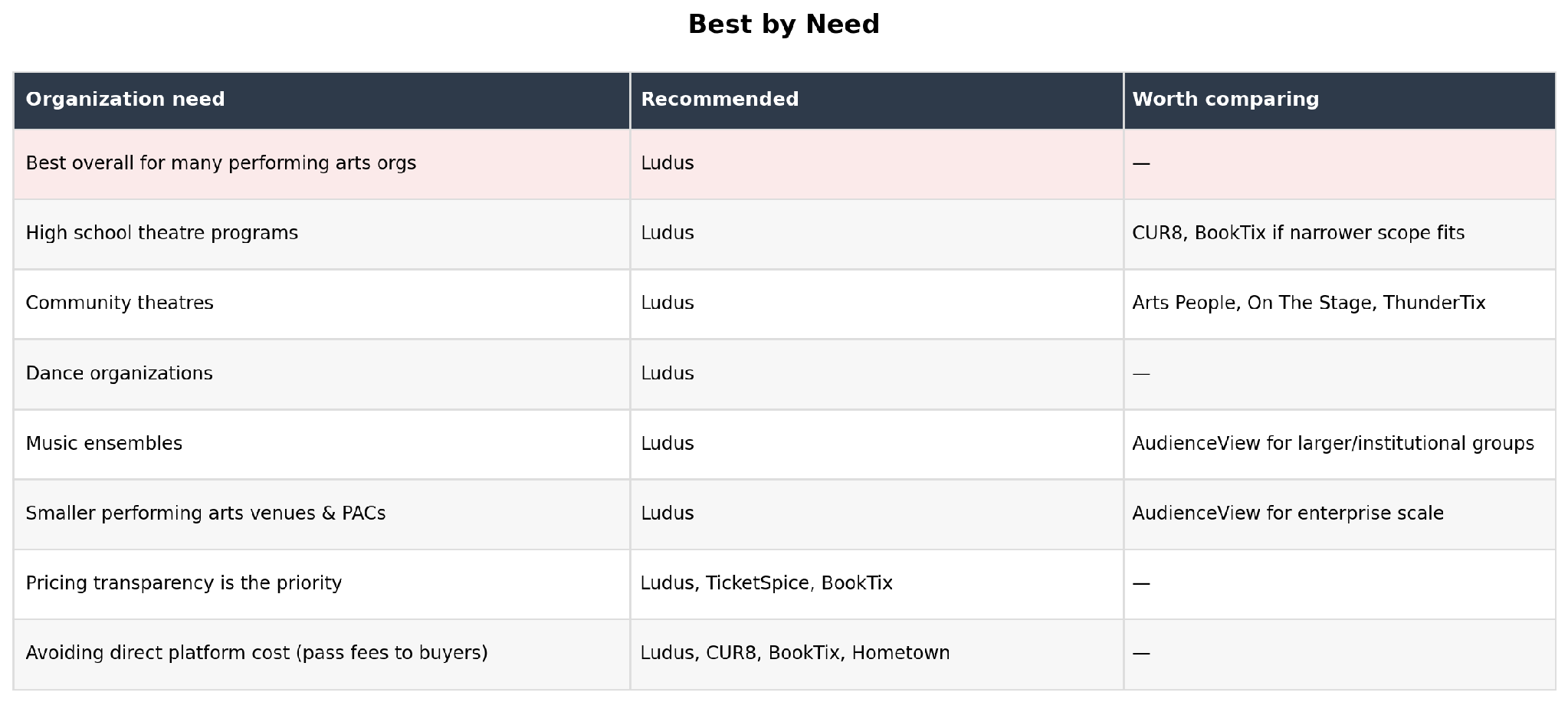
Best overall for many performing arts organizations
Ludus is one of the strongest overall choices because it combines ticketing, fundraising, marketing, patron CRM, volunteer management, collections, and front-of-house tools in one platform, while keeping pricing unusually transparent for this category.
Best for high school theatre programs
If you want a system that goes beyond ticketing and also supports fundraising, volunteer management, collections, registrations, marketing, and patron communication, Ludus is one of the strongest fits. CUR8 and BookTix are still worth considering if your needs are narrower and ticket-selling is the main job. CUR8 may appeal more if MTI integration and production management matter to you.
Best for college and university programs
This one depends on specific needs. Ludus fits department-level performing arts operations. AudienceView Campus targets institution-wide deployment. Both offer secure integration and robust reporting.
Best for community theatres
Ludus is a strong all-around fit for many community theatres because it covers ticketing, fundraising, volunteers, patron data, and front-of-house operations without long-term contract pressure. Arts People may make sense if donor CRM depth and Neon One ecosystem alignment are your top priority. On the Stage is worth a look if marketing automation is the main deciding factor. ThunderTix can fit if reserved seating and season packages are at the center of your decision.
Best for dance organizations
Ludus is a strong fit when ticketing is only one part of the picture and you also need registrations, fundraising, marketing, merchandise or concessions, and volunteer coordination.
Best for music ensembles
Music groups often need flexible ticketing, patron communication, donor support, and clean front-of-house tools without enterprise overhead. Ludus is a strong option when you want ticketing, fundraising, marketing, and patron CRM working together in one platform.
Best for smaller to medium performing arts venues and PACs
Ludus is a strong fit for many smaller venues because it supports multi-event management, flexible seating, concessions, and patron data at a transparent per-ticket cost. AudienceView is better known on the enterprise side for larger venues and universities that want a heavier institutional platform.
Best for large or development-heavy institutions
Spektrix or AudienceView. Both are built for larger groups where a designated team can monitor workflows. Ludus is worth a look when broader day-to-day operating tools and transparent cost matter more than advanced operations.
Best if pricing transparency matters
Ludus, TicketSpice, and BookTix do a better job than most of publishing usable pricing information up front.
Best no-cost-to-organization options
Ludus, CUR8, BookTix, and Hometown all appeal to schools and community groups looking to avoid direct platform cost by passing fees to buyers. Among those, Ludus offers one of the broadest operational toolsets.
What most theater ticketing software comparisons miss
This is where most comparison pieces get thin.
They compare software as if every organization is making the same decision. They are not.
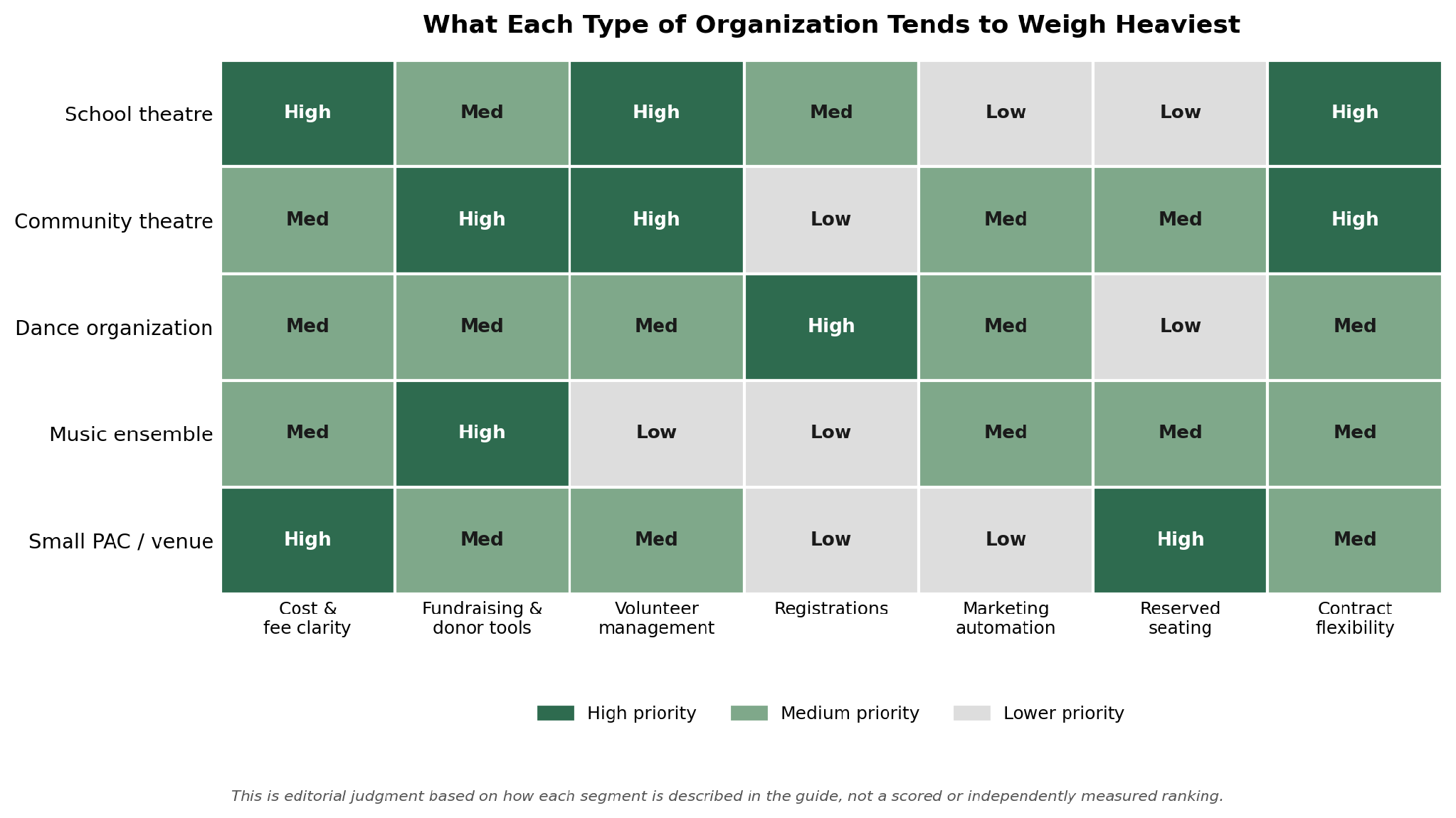
A school theatre program may care most about low cost, easy setup, volunteer usability, and the ability to collect money for more than tickets. A community theatre may care more about reserved seating, donor relationships, subscriptions, and self-service control. A dance organization may need registrations, merchandise, and recital logistics alongside ticketing. A music ensemble may care more about donor support, simple audience communication, and flexible selling. A performing arts center may need to support very different event types without getting buried in enterprise complexity.
That is why feature checklists only get you so far.
For performing arts organizations, the better questions usually sound like this:
Can a volunteer learn the box office quickly?
Will the company actually help us onboard and move our patron data cleanly?
Can we manage donations, marketing, patron segmentation, volunteers, and ticketing in one place?
What does support look like before and during live events?
What happens in the off-season?
Can we keep our own brand in front of patrons?
Those questions tell you more than a polished demo ever will.
How we evaluated the platforms
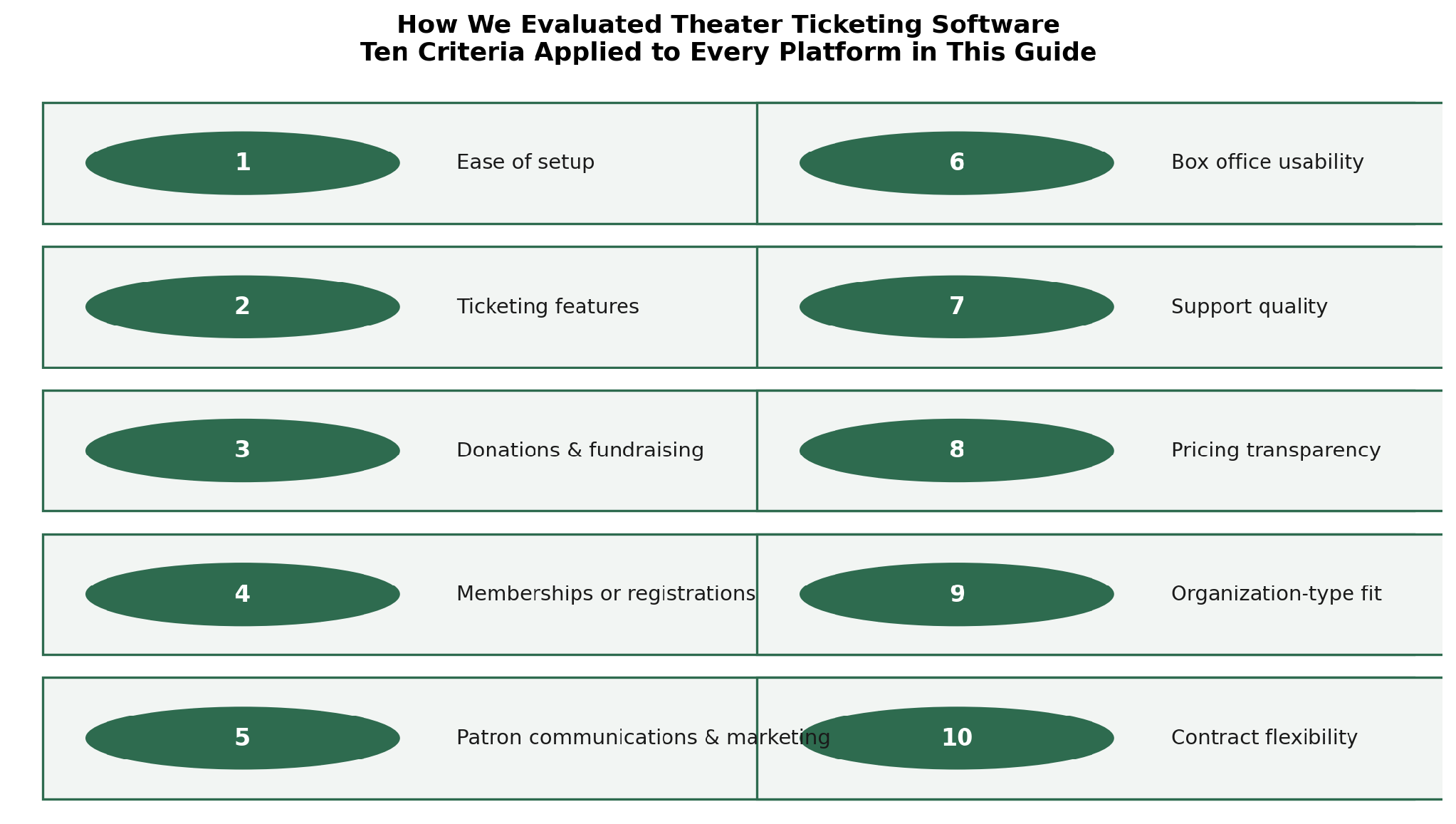
We evaluated these platforms across ten criteria that reflect how performing arts organizations actually buy and use ticketing software: ease of setup, ticketing features, donations and fundraising, memberships or registrations, patron communications and marketing, box office usability, support quality, pricing transparency, organization-type fit, and contract flexibility.
A feature name alone did not earn full credit. We looked for current documentation showing the workflow, current pricing and policies, product demonstrations, written confirmation, and case studies tied to a specific result. We separated dedicated features from general-purpose tools, outside integrations, workarounds, and claims that could not be verified publicly.
That matters because a platform can look impressive in isolation and still be a poor fit for your actual season.
- Ease of setup and onboarding: Can a non-technical director or volunteer get live in hours, not weeks?
- Ticketing features: Reserved seating, general admission, season passes, flex passes, ticket transfers, digital wallet support, waitlists.
- Donations and fundraising: Can patrons donate during checkout? Are standalone fundraising campaigns, recurring donations, and donor levels supported?
- Memberships, classes, and registrations: Does the platform handle class signups, camp registrations, payment collections, or membership management?
- Patron communications and marketing: Built-in email marketing, audience segmentation, templates, scheduling, and analytics, or does it require a separate tool?
- Box office and admin usability: How fast is the day-of-show experience? Can a new volunteer learn the box office in 15 minutes?
- Support quality and availability: Real human support before and during events? Evenings and weekends? Response times?
- Pricing transparency and fee structure: Are fees published? Does the stated fee include credit card processing? Are there fees on cash, check, or comp tickets?
- Fit by organization type: Was this platform built for performing arts, or adapted from somewhere else?
- Contract flexibility: Long-term contracts? Can you leave? Can you export your data?
For another comparison resource, visit EventTicketingSystem.com.
What to look for before you choose a platform
1. Pricing that is actually understandable
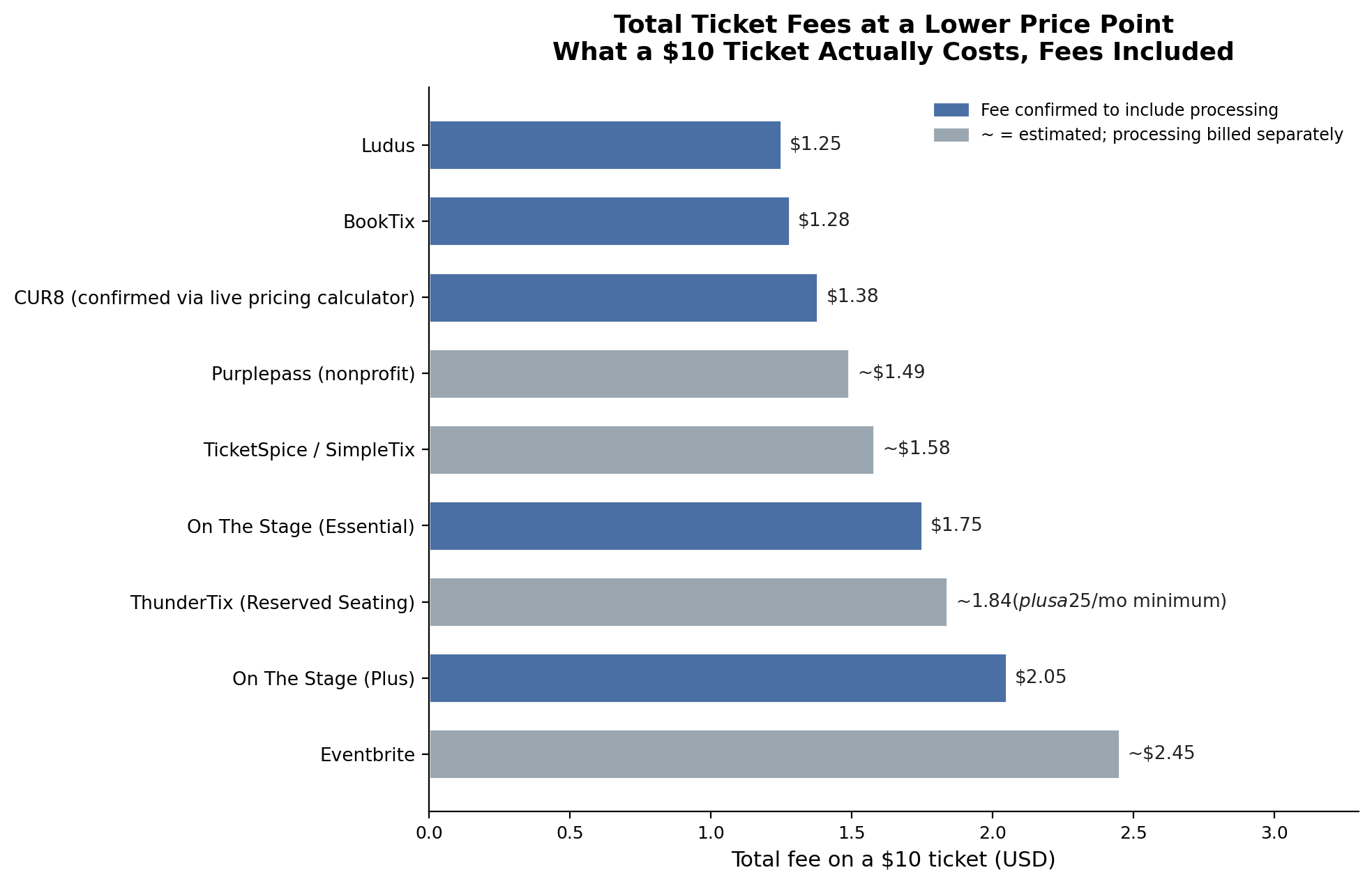
Do not stop at the headline fee. Ask what is included, what is separate, and what still gets charged on cash, check, comp, and free tickets. Ask whether credit card processing is already included or billed on top. Ask about setup fees, seating chart fees, email fees, donation fees, merchandise fees, and monthly costs. A low ticket fee means very little if the rest of your season gets more expensive. (Prices are as of the last edit and may have changed. Check each vendor’s website for a clear explanation of pricing. If you have to call to get a price, treat that as a warning sign.)
Concession fees require a different example
A $10 ticket tells you very little about a concession order containing four $2 products.
Ludus Retail charges 2.9% plus $0.30 once per completed transaction. An $8 basket containing several products carries a $0.53 card fee. BookTix publishes a $0.50 fee for generic Items priced below $3, but its documentation does not explain every combination of quantities and Item types. We did not invent a basket total BookTix has not confirmed.
The fair distinction is already clear: BookTix lets an organization sell an Item that happens to be a concession. Ludus provides a separate system for running in-person concession and merchandise sales.
Calculate the whole season
Ask about processing, monthly minimums, setup, seating charts, donations, registrations, concessions, refunds, chargebacks, and fees on cash, checks, comps, and free events. “Pass the fee to the buyer” simply means the patron pays it.
2. Real onboarding help
A lot of buyers ask whether they “own their data,” but that is only part of the issue. A better question is this: will the company help you migrate patron, purchase, donor, membership, and seating history, and will that history remain usable? Then ask what you can export, in what format, and what happens to data and payouts if you leave. Can you export your data in a format you can actually use? Will someone help make sure it is mapped correctly during onboarding? That is what most organizations are really asking when they talk about data. Good onboarding is not a courtesy. It is part of the product.
3. Volunteer usability
This gets overlooked all the time. If your team changes year to year, volunteer usability is not a bonus feature. It is part of the product. A platform that looks powerful in a demo but is hard to teach at the box office will cost you more in stress than it saves you in theory. The best platform is the one your volunteers can actually run on show night.
4. Support when timing matters
Support quality is easy to ignore when everything is calm. It matters most when it is not. Ask what support looks like before and during events, on weekends, and in the evening. Ask whether you can reach a real person close to curtain, not just submit a ticket and hope. A 24/7 help center is not the same thing as a live person at 7:20 p.m. on Saturday.
5. More than ticketing, if you actually need it
Some organizations truly only need to sell tickets. Others need fundraising, volunteer signups, concessions, registrations, marketing, payment collections, and patron history in one place. If your operation is the second kind, a ticketing-only tool can turn into several extra systems and several extra headaches. Ticketing is rarely the only problem a performing arts organization is trying to solve.
6. Workflow works for you
A membership tool should manage renewals and benefits. A registration system should collect participant details, forms, payments, waivers, capacity, and attendance. Have a volunteer sell seats, exchange a ticket, process cash, check in a guest, and close the station. A renamed field and an “easy” demo prove very little.
Recommendations by organization type
Best for high school theatre programs
School theatre programs usually need low cost, minimal training for volunteers who change every year, fast setup, reserved seating, and the ability to collect money for things beyond tickets.
Ludus is one of the strongest overall fits if you want one system that goes beyond ticketing. It includes fundraising, volunteer management, collections, marketing, patron CRM, and front-of-house tools, and it does not require setup fees, annual fees, or contracts. CUR8 is worth considering if you specifically value production scheduling and MTI integration. BookTix remains a practical option if ticket-selling is genuinely all you need. Hometown can make sense if your district already uses it for sports and wants one campus-wide system, though its performing arts depth is not the same.
Best for community theatres
Community theatres usually need reserved seating, donor support, patron communications, marketing tools, and a box office that volunteers can run without drama.
Ludus is a strong all-around fit because it combines ticketing, fundraising, marketing, volunteer management, patron CRM, and self-service event tools without long-term contract pressure. Arts People is more likely to appeal if deep donor management inside the Neon One ecosystem is the main priority. On the Stage can make sense if marketing automation is the deciding factor and paid staff will actually use those tools. ThunderTix is solid if reserved seating and season packages are the primary concern and year-round volume justifies the monthly fee.
Best for dance organizations
Dance organizations often need multiple showtimes, family-friendly ticketing, costume or merchandise sales, and class registrations alongside ticketing.
Ludus is a strong fit when you want one platform for the broader operational picture, including collections, fundraising, marketing, patron CRM, and volunteer coordination. That makes it more relevant to dance groups than many generic ticketing platforms.
Best for music ensembles
Music ensembles often need flexible seating, donor support, audience segmentation, and a clean patron experience without enterprise overhead.
Ludus is a strong fit for music groups that want ticketing, fundraising, marketing, and patron CRM working together without layering on multiple systems. Larger or more institutionally complex organizations may still compare AudienceView or other enterprise tools.
Best for small venues and performing arts centers
If you manage a small performing arts center, multi-use venue, or concert hall, you likely need flexible seating, multi-event management, concessions, renter coordination, and reporting that can keep up.
Ludus is a good fit for many small-to-mid-sized venues with a performing arts focus. AudienceView is the better fit for larger venues with enterprise budgets, dedicated staff, and long-term commitment. ThunderTix remains a solid mid-range option if reserved seating and season management are primary.
The platforms
1. Ludus
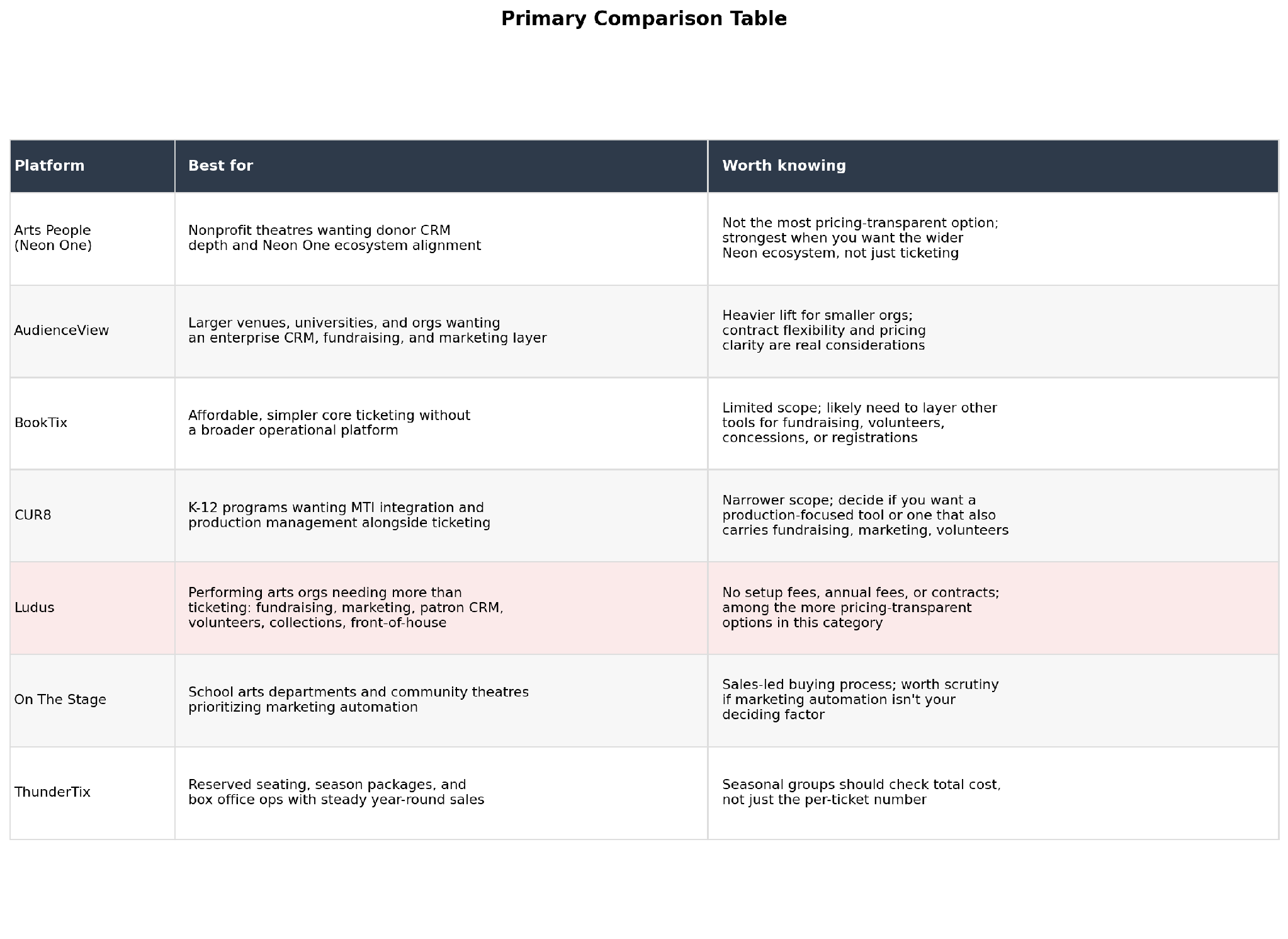
Best for: K-12 schools, community theatres, dance studios, music ensembles, and small-to-mid-sized performing arts organizations that need a modern platform built specifically for the arts.
Ludus began as a side project between a high school theatre director and a former student who wanted a better answer to a problem they could not solve with the tools already on the market. That origin still matters because the platform is built around the realities of performing arts organizations, not generic event management. Today, Ludus serves 5,500+ organizations across all 50 states.
What stands out is breadth without contract pressure. Ludus combines ticketing, fundraising, marketing, patron CRM, volunteer management, collections, and front-of-house tools in one platform. Its public pricing and product pages also state no setup fees, no annual fees, no contracts, no fees on cash, comp, or free tickets, no chargeback fees, recurring donations, donor tips that can eliminate Ludus platform fees on qualifying online donations, and live 7-day customer support.
Watch for: Stripe is the processor. There is no public API as of this edit. International language and currency support are still more limited than some enterprise platforms.
Pricing: No setup fees, no annual fees, no contracts. Ticket fees are listed as 5% + $0.75 with card processing included. Donation fees are listed as 3.5% + $0.50 for donations over $3.00, and 0% on fundraising campaigns, with donor tips available to remove Ludus platform fees on fundraising pages. Ludus Retail costs 2.9% plus $0.30 per card transaction, with no fee on cash sales.
2. Arts People by Neon One
Best for: Nonprofit theatres already aligned with the Neon One ecosystem and willing to prioritize donor CRM depth.
Arts People can make sense for organizations already invested in Neon One and wanting ticketing tied closely to that world. Its appeal is clearest for groups where donor management depth is the main driver.
The tradeoff is that this is not the most pricing-transparent option in the field. It is most compelling when an organization actively wants the broader Neon ecosystem, not just ticketing. Reviews describe customer support as inconsistent.
3. AudienceView
Best for: Larger venues, universities, and organizations that want a heavier enterprise-style platform with CRM, fundraising, and marketing layers.
AudienceView is a recognized option for larger arts organizations and venues. It is a serious platform, but it can also be more than smaller arts organizations need.
That makes AudienceView a real option for some organizations, but a heavier lift for others, especially if contract flexibility and pricing clarity matter.
4. On the Stage
Best for: School arts departments and community theatres that place a high value on marketing automation and are comfortable with a more sales-led buying process.
On the Stage earns attention because of its marketing automation angle. For organizations with paid staff who will actually use those tools, that can matter.
The caution is buyer clarity. If marketing automation is not the deciding factor, plenty of groups will want to ask harder questions about overall flexibility, total cost, and what still has to happen outside the system.
5. ThunderTix
Best for: Organizations focused on reserved seating, season packages, and box office operations, especially with steady year-round sales.
ThunderTix has a real seat at the table for reserved seating and season management. That can work well for some venues.
It also means seasonal groups need to look closely at the total cost picture, not just the per-ticket number. Pricing can fluctuate. There is a real emphasis on AI usage as well.
6. CUR8
Best for: K-12 theatre programs that specifically want MTI integration and production management alongside ticketing.
CUR8 has a clear niche. If MTI integration and production scheduling are central to your process, it deserves a brief look.
The main question is scope. Buyers should decide whether they want a platform centered more tightly around school production workflow or one that also carries more of the surrounding season, like fundraising, marketing, volunteer management, collections, and patron data.
7. BookTix
Best for: Smaller K-12 programs that want simpler core ticketing and do not need a broader operational platform.
BookTix has long been a practical option for schools and small community groups that mainly want to sell tickets clearly and affordably.
Its strength is simplicity. Its limitation is scope. If you need fundraising, volunteer management, concessions, registrations, or deeper marketing tools in the same system, you will likely end up layering other tools around it.
Questions to ask before you switch ticketing platforms
Before you sign anything, ask these questions directly.
What are all the fees, including processing, setup, chart creation, email charges, donation or merchandise fees, and charges on comp, free, cash, or check tickets?
Will you help me migrate patron data, purchase history, donor records, and seating information, and is that help included?
Can I export my data whenever I need it in a usable format?
Will you help me make sure it is mapped correctly during onboarding?
What does support look like before and during live events?
Can a volunteer learn the box office in 15 minutes?
Do I need separate tools for fundraising, volunteer management, concessions, registrations, marketing, and patron communication?
What happens if I want to leave after one season?
Frequently asked questions about theater ticketing software
What is the best ticketing software for school theatre?
Ludus is the strongest overall choice for K-12 performing arts programs because its published price includes processing and the same account can manage tickets, reserved seating, fundraising, volunteers, classes, collections, marketing, patron records, and concessions. BookTix is worth comparing when basic ticketing is the main job.
What is the best ticketing software for community theatre?
Ludus is the strongest overall fit for community theatres of all sizes because it combines reserved seating, fundraising, marketing, volunteer scheduling, memberships, patron CRM, and concessions without a standard contract or annual fee. Size alone does not make a community theatre an enterprise buyer. A theatre with specialized procurement requirements should still compare Spektrix and AudienceView.
What is the best ticketing software for dance companies?
Ludus is the strongest overall choice for many dance organizations because recital ticketing can live beside classes, collections, family payments, volunteers, fundraising, and in-person merchandise or flower sales. TicketSpice is worth comparing when complex registration logic matters more than managing a performing arts season.
What is the best ticketing software for music ensembles?
Ludus is a leading choice for small-to-mid-sized music ensembles that want ticketing, fundraising, marketing, and patron records in one place. Ensembles with a dedicated development department or complex institutional requirements should also compare Spektrix and AudienceView.
What is the best ticketing software for performing arts centers?
Ludus is the strongest overall choice for many small-to-mid-sized performing arts centers because it combines multiple event types, reserved seating, patron data, concessions, fundraising, and reporting without a required annual commitment. Larger venues may prefer AudienceView or other enterprise platforms if they need deeper institutional infrastructure and are comfortable with more complexity.
Which ticketing software has the clearest pricing?
Ludus, BookTix, and TicketSpice publish enough information to calculate common online ticket scenarios. Arts People publishes 99 cents per ticket without stating the transaction rate. AudienceView, Spektrix, and Tixly require a quote for the actual rate.
Can one product manage tickets, fundraising, volunteers, classes, and concessions?
Yes, but not every platform does it equally well. This is one of the clearest separation points in the market. Ludus brings ticketing, fundraising, marketing, volunteer management, collections, patron CRM, and front-of-house tools into one platform. Other systems may cover part of the work through generic Items, added modules, outside integrations, or ticket-centered workarounds.
What should I look for before switching ticketing platforms?
Look past the demo. Ask about total cost, not just ticket fees. Ask about data migration help, support before and during events, volunteer usability, contract flexibility, off-season cost, and whether the platform can handle more than seat sales if your organization needs more than seat sales.
What matters most when choosing theater ticketing software?
Fit matters most. The right platform is the one that supports how your organization actually runs, how your people actually work, and what your season actually demands.
Final thought
The best theater ticketing software is the one that makes your season easier to run.
A polished demo is nice. A long feature list can be nice too. Neither matters much if the platform creates more friction for your volunteers, more cost in the off-season, more confusion in your box office, or more systems for your team to manage.
For many performing arts organizations, the strongest choice is not the one that looks best in theory. It is the one that fits the real work, ticketing, fundraising, marketing, volunteers, registrations, concessions, patron communication, and support when timing matters. That is where Ludus earns its place at the top of the conversation, and that is where buyers should judge every other option.
See how Ludus actually works
This guide asks buyers to look beyond feature labels and see how the product actually works. Take the same approach with Ludus.
Watch the Self-Serve Tour
Book a Demo


New resources,
straight to your inbox
We'll send you the latest guides, spotlights, and webinars — no noise, just the good stuff for arts organizations like yours. No spam, unsubscribe anytime.


























.png)