Reserved Seating vs. General Admission: What Ludus Data Shows
Direct Answer:
Based on Ludus transaction data, reserved seating events tend to sell more tickets and generate more revenue than general admission events across K-12, community theatre, and professional theatre segments.
Intro
Most performing arts organizations treat reserved seating as a patron convenience. A nice option when the venue allows it. Ludus data suggests it may influence buyer behavior, not just the patron experience. Across the events analyzed, reserved seating events sold more tickets than general admission events by a wide margin. That pattern appears across multiple organization types and venue sizes represented in the dataset.
Key Insight
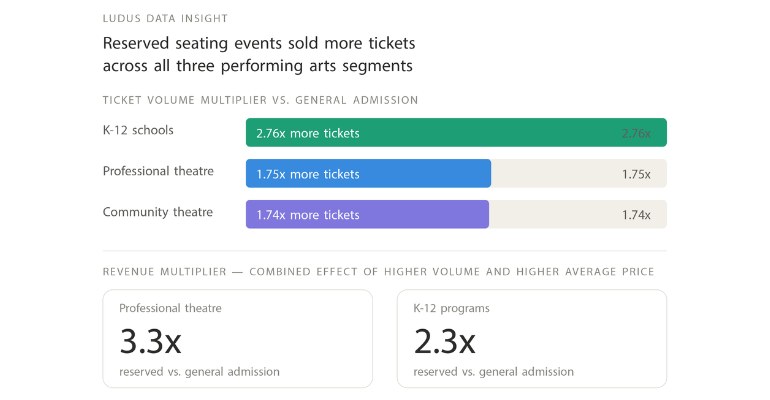
Looking at thousands of ticketed events across the Ludus platform, the difference between seating types is consistent. K-12 school productions using reserved seating sold an average of 2.76 times more tickets than comparable general admission events. Professional theatres showed a 1.75x difference, while community theatres came in at 1.74x.
In this analysis, revenue multiplier reflects the combined effect of higher ticket volume and higher average ticket price. For professional theatres, that multiplier reaches 3.3x. For K-12 programs, it sits at 2.3x. The pattern is directionally consistent across all three segments.
These figures come from Ludus transaction data and reflect observed differences between event types. They are correlational. Reserved seating tends to appear alongside other indicators of organizational sophistication, marketing investment, and production quality. The data cannot isolate seating type as the sole cause. What it does show is a strong, consistent association worth paying attention to.
What This Means
Four buyer behaviors may help explain this pattern across segment types.
Guaranteed seats reduce buyer hesitation. A patron who knows seat B-12 is theirs will commit weeks in advance. A patron facing general admission often waits, and some never complete the purchase.
The advance sales window expands. Reserved seating sales distribute over two to four weeks. General admission sales tend to cluster close to the event date, which leaves little runway to respond if early momentum is slow.
Group coordination becomes easier. Families and groups can confirm seats together before committing. That removes one of the most common reasons group purchases stall or get abandoned.
Reserved seating sends a signal before the patron ever clicks “buy.” It tells them the organization has thought about the experience, not just the transaction. When patrons feel an event is organized and worth planning around, they are more likely to buy early and come back.
What To Do With It
Look at your last few productions. If you ran general admission, compare your average tickets sold against similar organizations in your segment and region. A meaningful gap is worth examining.
If reserved seating has felt like too much setup for the return, the ticket volume data suggests that calculation may be worth revisiting. The difference in average sales between seating types appears often enough, across enough events, to take seriously.
If you already use reserved seating, look at whether your pricing reflects the value patrons assign to seat selection. The data shows reserved seating events tend to command higher average prices alongside higher volume.
Reserved seating is not automatically the right fit for every event. Small productions, casual formats, or highly flexible spaces may still work better with general admission. But when seat location matters to your audience, the data strongly favors giving patrons the ability to choose.
Closing
The difference between reserved seating and general admission is not just about setup. It appears to change how people decide to buy, how far in advance they commit, and how many of them follow through. The pattern is consistent enough across performing arts segments to be worth checking against your own numbers.
New resources,
straight to your inbox
We'll send you the latest guides, spotlights, and webinars — no noise, just the good stuff for arts organizations like yours. No spam, unsubscribe anytime.


























.png)