
Why National Averages Are the Wrong Benchmark for Performing Arts Ticket Pricing
Direct Answer:
The best benchmark for performing arts ticket pricing is not a national average. It is pricing from similar organizations in your region, producing similar work, in similar venues.
Intro
Most performing arts organizations that think about pricing benchmarks reach for the same number: what does everyone else charge? The problem is that "everyone else" covers a lot of ground. A regional theatre in rural Michigan and one in suburban San Francisco are not competing for the same patrons, operating in the same economy, or drawing from the same audience expectations. Pricing against a national average treats them as if they are. The data suggests that is the wrong comparison to make.
What the Data Shows
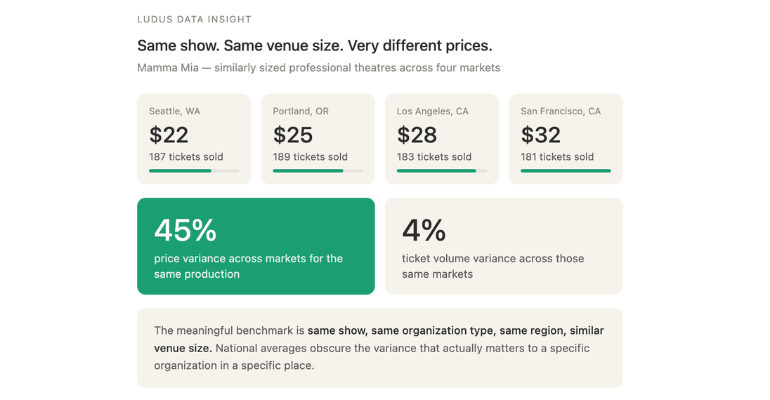
Looking at productions of Mamma Mia across similarly sized professional theatres on the Ludus platform, ticket prices ranged from $22 in Seattle to $32 in San Francisco. That is a 45 percent variance across comparable organizations producing the same show. Ticket sales across those same venues varied by only 4 percent, between 181 and 189 tickets per event.
In this comparison, higher-priced markets were not losing audiences. They were charging what their local market supported. The production, venue size, and ticket volume were comparable. The price was not, and that difference reflected local market conditions rather than anything about the show itself.
A similar pattern appears in community theatre data, though the variance between markets tends to be smaller than in professional theatre.
In Ludus transaction data, urban and coastal markets often supported meaningfully higher prices than rural and inland markets for comparable productions. That pattern is consistent enough to matter, but local market conditions, audience demographics, production quality, and organizational reputation all contribute. Geography alone does not determine what a market will support. It is one of several factors that peer benchmarking accounts for when national averages cannot.
What This Means
The meaningful comparison is same show, same organization type, same region, similar venue size. That comparison can change the picture significantly.
An organization pricing at $18 for a production where similar organizations in the same state charge $22 to $24 is not pricing conservatively. It is pricing below its actual peer group. An organization in a smaller or lower income market that benchmarks against premium coastal data and tries to close that gap aggressively may price itself out of its own audience. Regional data protects against both errors.
National averages are not useless. They give a reasonable sense of the broad market. But they obscure the variance that actually matters to a specific organization in a specific place. A blended figure that averages coastal premium markets with rural community venues does not tell you what your audience expects to pay. It tells you what a very wide range of audiences pays on average somewhere in the country.
What To Do With It
Before your next season, identify your actual peer group. That means organizations in your state or region, producing similar work, at a comparable venue size. If you have access to peer pricing data filtered by region and organization type, use it as your primary reference rather than a national figure.
Check whether your current pricing reflects your market or a market somewhere else. For organizations that have not updated prices recently, local peer data can clarify the gap faster than any national benchmark.
Closing
Performing arts pricing is local. A national average tells you something about the broad market. It does not tell you what your audience expects to pay or what your actual peers are charging. That answer lives in your region, not in a national figure.
FAQ
What is the best benchmark for performing arts ticket pricing?
The best benchmark is pricing from similar organizations in your region, producing similar work, in similar venues.
Should theatres use national average ticket prices as a guide?
National averages can show broad market direction, but they are usually too broad to guide pricing for a specific organization.
Why does regional ticket pricing matter?
Regional pricing matters because audience expectations, local income, competition, venue size, and organization reputation vary widely by market.
Does ticket price affect attendance at performing arts events?
In the Ludus dataset, ticket volume for the same production varied by only 4 percent across markets where prices differed by 45 percent. Price alone does not appear to be the primary driver of attendance within a reasonable range.
How do I find out what similar theatres in my region are charging?
Peer benchmarking tools that filter by show title, organization type, region, and venue size give the most useful comparison. National databases and general surveys are a starting point but rarely specific enough to act on directly.


New resources,
straight to your inbox
We'll send you the latest guides, spotlights, and webinars — no noise, just the good stuff for arts organizations like yours. No spam, unsubscribe anytime.
































.png)